Showing posts with label Invisible Cities. Show all posts
Showing posts with label Invisible Cities. Show all posts
Friday, 21 October 2016

Reflection on Invisible Cities
The Invisible Cities Project challenged me beyond my expectations. I got to a point where I didn't think I would be able to achieve the brief due to the extent I have struggled with painting digitally within any reasonable span of time.
Having actually pushed myself to finish it though I am elated. I always have sttong ideas in my mind of exactly how I want something to look, feel, etc, which is part of what makes my workflow so slow. I simply haven't had the practice yet to achieve what's in my head. However, since I had to just surrender the absolute control I wanted, I am surprised to find that my resultant work is entirely unexpected, in a way that I'm actually happy with and I can actually paint something decent without spending eternity on it. I would have wanted to spend far, far more time on them had there not been the constraint, and I'm glad I didn't, because otherwise, to me at least, my work would have been predictable.
I am however looking forward to the next project resetting everything, as I now have much clearer and realistic ideas on how to manage my workload and actually maybe enjoy having to be so busy.
Animated GIFs of Final Paintings
 |
| Exterior Shot Build Up |
 |
| Low Angle Exterior Shot Build Up |
 |
| Interior Establishing Shot Build Up |
Ersilia - Final Concept Paintings
 |
| Final Exterior Establishing Shot |
 |
| Final Low Angle Shot |
 |
| Final Interior Establishing Shot |

Sunday, 9 October 2016

Saturday, 8 October 2016
Friday, 7 October 2016


Wednesday, 5 October 2016

Tuesday, 4 October 2016


Wednesday, 28 September 2016
City Thumbnails 1-12
These are my initial thumbnails from last week. The thumbnails I'm working on now will be quite distinctly different from these as I'm ensuring they are all informed by visual research as per Jordan's recommendation, which I'll be posting later today and over the next few days
These first 12 were drawn purely off the top of my head as an experiment, but I definitely need references to get the results I want. I also spent altogether too long wrestling with Photoshop brushes - I'm having difficulty getting any degree of sharpness without the thumbnails turning into line drawings, but I'm determined to do at least the majority in Photoshop in order to improve prior to having to tackle the final paintings. If anyone has any specific brushes or settings they can recommend, I am all ears.

I wrote a short description of how I imagined Anastasia before I started thumbnailing in order to get a clear idea of what I was after. The thumbnails don't necessarily live up to the same level of detail, but this is their basis.
Anastasia is an opulent
merchant city, seemingly formed about a lavish upper class who drive the demand
for jewelry, cuisine, finery etc. This in turn attracts craftsman and trade,
arriving via the waterways which have sprung up as infrastructure necessary to
import raw materials, and ease the pressure on the congested narrow streets.
Anastasia can make you a rich man, but only by the standards of other Cities –
no matter how great a craftsman or merchant you may be, you will never possess
wealth enough to join the city’s upper echelon.
The streets are
littered with merchants plying their wares from stalls and open tents, labourers
sorting incoming shipments at the myriad of docks, with jewelers, blacksmiths,
weavers and tailors all setting up shop in the immediate vicinity – being too
far from a dock will mean you lose out on incoming shipments, so difficult is
it to move cargo through the throng of people cascading through the city. So
busy is the ground level of the city that by necessity a melange of kites rises
above the crowds, riding the ever present breeze, marking out streets, City
Authorities, districts, some serving as signs for shops and taverns, else due
to the city’s concentric, repeating design, you would be lost in a matter of
moments.
Every building is
organised thusly – what would be the first two floors are extensions of the
streets, high arched tunnels and niches cut into each building’s foundations. These
halls ring with activity, clangs, clatters and shouts echoing off the domed ceilings,
for this is where the common folk set up their workplaces and homes, some
little more than hovels. It is here that all of wonders of Anastasia are
produced. Where the majority of these goods can be found, however, is up above,
where any ordinary building’s 3rd floor would be, but in Anastasia this
is where the truly liveable space actually starts. Lavish mansions and above
ground gardens sit atop the common sprawl, occupied solely by fabulously
wealthy Anastasians, who act as though the people below were no more than rats
scurrying about the house’s foundations. No true Anastasian ever alights to
ground level – their every need provided for by servants who roam the ground
city on their masters behalves. The sole exception is when they leave their abodes
via their private docks, in order to visit other upper class residences or
buildings.
Many of course resent
the exorbitant wealth of the ruling class of Anastasians, often resulting in
theft, but every would-be criminal is without fail stymied by the densely
packed crowds blocking their escape and can only watch helplessly as above the
crowd, the blue kites of the City Guard slowly bob towards them.
Tuesday, 20 September 2016
Film Review - Das Cabinet des Dr. Caligari, Robert Wiene (1920)
More striking though than its enduring impact, is how effectively even a contemporary audience, spoilt by decades of films replete with spoken dialogue and vast repetoires of SFX, can engage with and digest its relatively complex, yet soundless narrative. There are three key visual and narrative elements that enable it to succeed even 96 years later.
Firstly, the unwaveringly persistent visual aesthetic. Wiene does not so much employ the more subtle mise-en-scène audiences have now grown accustomed to, as punch viewers in the face with geometric unrealism. Nearly all of Caligari's buildings, structures, and even objects of furniture are inescapably presented as illogically angular forms, oppresively looming over each scene and its characters, cutting off the skyline, and creating a vague sense of claustrophobia. The iconic scene in which the Somnambulist, Cesare, doggedly sets off along the zig-zag of Holstenwall's skyline, heroine tucked under his arm (see fig.1.), inspires a sense of the sinister, not just due to the inherent nastiness of kidnapping, nor Cesare's discomfortingly slender figure, but because the environment itself narrows and jerks in an illogical, visually jarring manner. Intriguely however, ignoring the prologue, the film initially maintains an almost light-hearted tone in spite of the negative connotations of the off-kilter mise-en-scène. That is because this is not Disney. A shape language has been established in film in the past century which tells us that sharp, angular imagery is inherently of the sinister, the evil, the aggressive, but one could argue that Caligari predates this rigid language, which in turn allows it to defy the jaded expectations of the contemporary audience. This contradiction of expectation leads into Caligari's second key element.
 |
| Figure.1 Cesare escaping across the rooftops of Holstenwall as he kidnaps the heroine, Jane (1920) |
The geometric awkwardness of Caligari may loan itself to inspiring angst in its audience, but this is not by design. Its actual purpose is arguably that of transition; the distorted forms, representative of the broken psyche of the film's hero, provide the audience with visual anchors to the real world, and the world of the hero's internal narrative, allowing a clear distinction between those scenes set in reality, which feature curves and perpendicular lines, and those set in the protagonist Francis' mind. An ideal comparison would be to Joseph Kosinski's Tron: Legacy (2010). Divisive as stereoscopic 3D in cinema may be, it was used beautifully in Tron: Legacy to differentiate between the setting of the real world and the digital - its opening and end scenes are shot in 2D, whereas all the scenes set in Tron's digital world of 'The Grid' are shot in stereoscopic 3D. So subtle is this transition that many audiences would have failed to notice, but this particular transition literally added an extra dimension to the world of 'The Grid', ironically making it more 'real' than the real world setting of the film's 2D scenes. Caligari achieved this 90 years prior merely by distorting our expectations of recognisable shapes - the audience inevitably becomes more engaged in the world which challenges their established schemas of a sane world.
This theory is further supported by a direct comparison of the appearance of Dr. Caligari himself (later revealed to be the director of the insane asylum in which Francis is revealed to be interned). In Francis' mind Dr. Caligari is exaggerated, his face shadowed and obscured by a needlessly thick glasses frame, dark bags beneath his eyes, his movements furtive and defensive (see fig.2.). These are the primary elements of what visually makes him an insidious, untrustworthy character. In reality Dr. Caligari is revealed to be a well-kempt, unassuming man with a professional air - entirely unthreatening, cleansed of his negative attributes. The distorted geometric theme of Francis' mind is not used to contribute to Dr. Caligari's perceived vileness at any point.
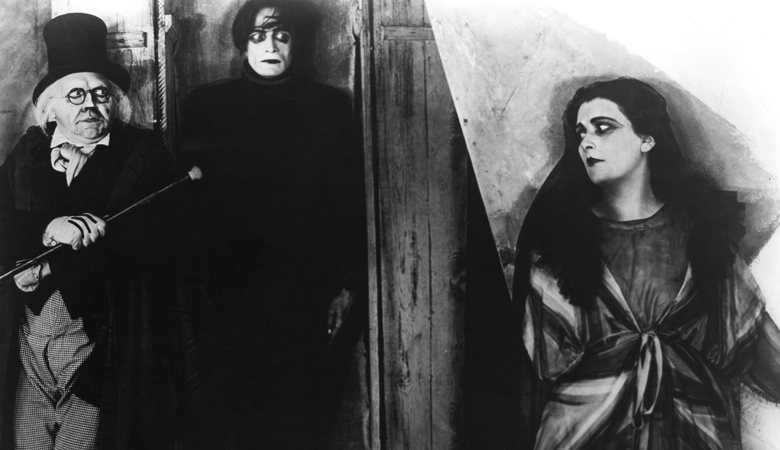 |
| Figure 2. Jane, lured by Dr. Caligari, encounters Cesare the Somnambulist (1920) |
A moment beforehand, the man whom Francis is addressing had explained that he had been driven from his home and family by spirits. This is a more than acceptable statement since it is of course a film. The audience has suspended its disbelief and is perfectly willing to accept that spirits are real. But, at the end of the film, this tale of tragedy, murder, and duplicity in which the audience has invested real emotion in our hero, and developed a healthy hatred of the antagonists, we snap back to the real world and it is revealed that Francis, and not Dr. Caligari, is the mental patient.
 |
| Figure 3. Opening scene (1920) |
In a glorious instant, the viewer is catapulted in reverse back through their narrative journey. The opening scene; the man on the bench, assaulted by spirits, is not a poor misbegotten soul - he is a lunatic, accompanied by Francis - chief lunatic incarnate, observing a third lunatic wander past (see fig.3.). Their sufferings are designs of their own fractured psyches. Francis has not been revealing his past, but weaving his personal fantasy, projecting his psychosis onto prevalent figures in his real life, his betrothed - the attractive female inmate Jane, the Somnambulist - yet another inmate, the notorious Dr. Caligari - the director of the asylum, the man responsible for Francis' treatment. It is notable that with regard to the antagonists, in reality Cesare is a younger, more attractive man, from Francis' perspective perhaps a potential love rival, and Dr. Caligari, the authoritarian figure within the asylum and therefore Cesare's master, the reason for Cesare's threatening presence, and a force actively working against Francis - hence the 'theft' of Jane, by Cesare upon being ordered to by Dr. Caligari. The narrative hasn't been pure fantasy; Francis has been projecting legitimate fears and concerns onto the people he perceives as their direct cause, the murders which occur early in the narrative are perhaps a representation of other asylum inmates placed in solitary confinement at the behest of Dr. Caligari.
A contemporary audience will struggle to bear the slower pacing of this aging film, but even now, the film sustains its audience by the hook and underlying purpose of its unique aesthetic. It pushes their expectations off-centre and holds them captive, denying the audience the visual conformity their brains are vying to find. And although audiences are spoilt wannabe films critics, the pacing is immediately forgiven for that instant of realisation in which the entire narrative is reinvented in the blink of an eye - as though it has been averaged out. The cathartic shock of the epiphany provided by the narrative twist is no less potent in this older medium than in recent films such as Christopher Nolan's Inception (2010) and The Prestige (2006), or M. Night Shyamalan's Unbreakable (2000). Until contemporary culture has worn these devices so thin as to be unbearably predictable, Robert Wiene's Das Cabinet des Dr. Caligari will continue to endure and surprise.
Bibliography
Das Cabinet des Dr. Caligari (1920) Directed by Robert Wiene
Edward Scissorhands (1990) Directed by Tim Burton
Corpse Bride (2005) Directed by Tim Burton and Mike Johnson
Shutter Island (2010) Directed by Martin Scorsese
One Flew Over the Cuckoo's Nest (1975) Directed by Miloš Forman
Tron: Legacy (2010) Directed by Joseph Kosinski
Inception (2010) Directed by Christopher Nolan
The Prestige (2006) Directed by Christopher Nolan
Unbreakable (2000) Directed by M. Night Shyamalan
List of Illustrations
Figure.1 Cesare escaping across the rooftops of Holstenwall as he kidnaps the heroine, Jane (1920) [Film Still] At: https://blogger.googleusercontent.com/img/b/R29vZ2xl/AVvXsEg-yIatCYIB-L3VSQuQitZoMNzhWJhmSSd9LY6BdFhU6HCnbIXbVFwcgJdxRJdqxcqeBf_O12Nb8Y804uioHt1RYfKv5pAVd77bRi2uW_hE7O5A4cGNGeIzm5VXrxpHYgPP9oRa7dMi1tQp/s1600/dr.-caligari-1.jpg (Accessed on 20.09.2016)
Figure.2 Jane, lured by Dr. Caligari, encounters Cesare the Somnambulist (1920) [Film Still] At: http://teegardennash.com/media/*MS/CabinetOfDr.Caligari-1.jpg (Accessed on 20.09.16)
Figure.3 Opening Scene (1920) [Film Still] At: http://i1.wp.com/moviessilently.com/wp-content/uploads/2014/11/caligari-06.jpg (Accessed on 20.09.2016)

Figure.2 Jane, lured by Dr. Caligari, encounters Cesare the Somnambulist (1920) [Film Still] At: http://teegardennash.com/media/*MS/CabinetOfDr.Caligari-1.jpg (Accessed on 20.09.16)
Figure.3 Opening Scene (1920) [Film Still] At: http://i1.wp.com/moviessilently.com/wp-content/uploads/2014/11/caligari-06.jpg (Accessed on 20.09.2016)

Concept Artist 'Who's Who?' - Kekai Kotaki
My chosen concept artist with relation to the Invisible Cities project is Kekai Kotaki. I discovered him as a result of being a huge fan of the artistic style of Guild Wars 2.
You can find him at http://www.kekaiart.com/ and he has a tumblr at http://kekai-k.tumblr.com/, both of which are seriously worth checking out.
Subscribe to:
Posts (Atom)